


Because I just did a long post about the moon for New Year’s Eve, today’s post was supposed to be all about tea time and dishes and cups and teapots, to  go with my Willard newsletter that starts going out today. ♥ But, Sunday night, we walked into town to have dinner and even though it wasn’t the “official” full moon yet, the island was SO beautiful, the harbor was SO alive — I couldn’t help but show you! We went home and checked the exact time the first full moon of 2012 would rise. And last night, we were ready. We were moonchasers! Reminded once again, it’s true, the best things in life are free!
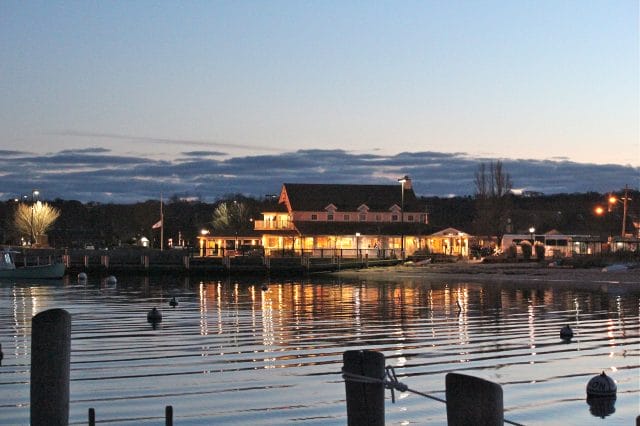 Sunday night is what got us started; here we are, just three blocks from home, on the town dock at Owen Park. The thing about living on Martha’s Vineyard, is that you don’t just get the moon, you get island ambience! Shore lapping, rippling water, flags flying, people going in and out of the golden light at the Steamship Building, the salty smell of the sea. A feast of beauty for the senses.
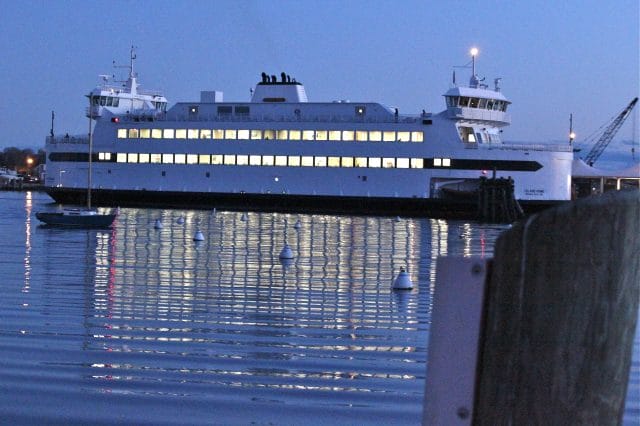 This bit of horn-blowing ambience is docked in front of the building in the first photo — when we got there, the ferry was loading up, getting ready for the forty-five minute trip across the sound to the mainland. The water rippled perfectly to catch the dazzling reflection from the boat windows . . . I can’t even believe we were standing right there, catching such a beautiful sight!
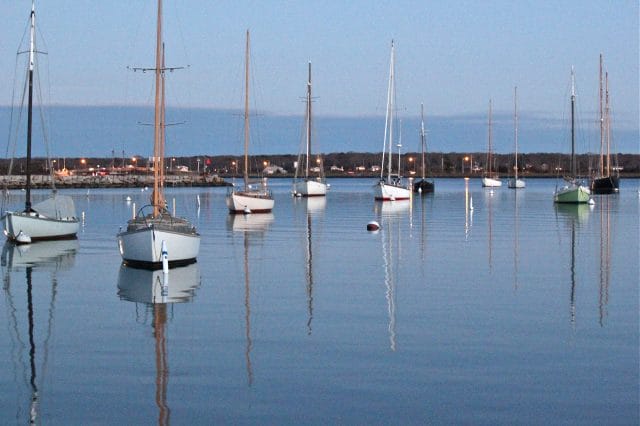 Water like glass for the sailboat masts too . . . this is supposed to be winter, but so far, it’s been hovering near the 50’s on most days; clear and cold at night.
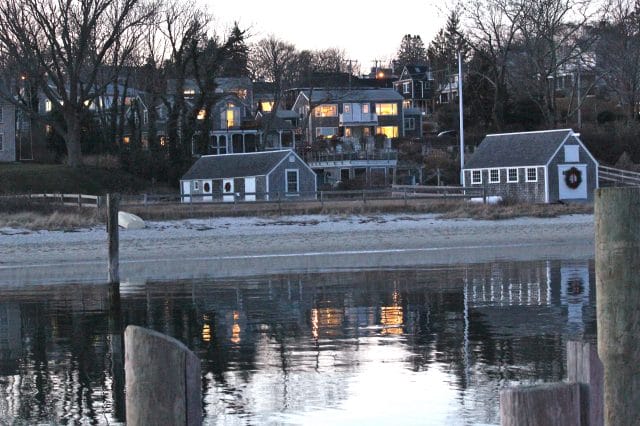 And behind us, the lights were beginning to come on in the little houses that hug the shore. But you are saying to yourself, where’s the moon? Didn’t she say something about the moon?
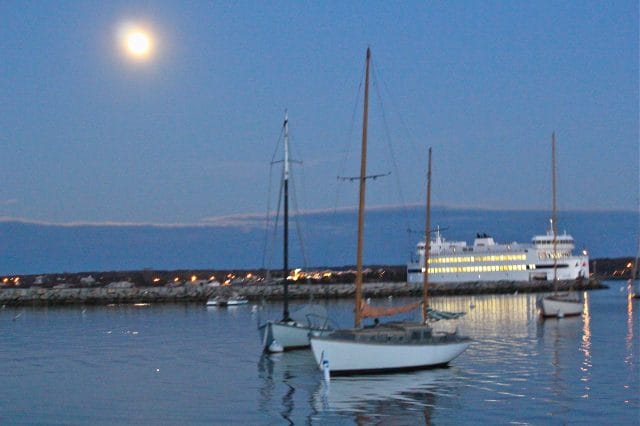 Oh yes she did! There it is! And there goes the ferry. When we left the house, we really weren’t expecting this, we were just going to dinner. . . but when we saw what was happening . . .
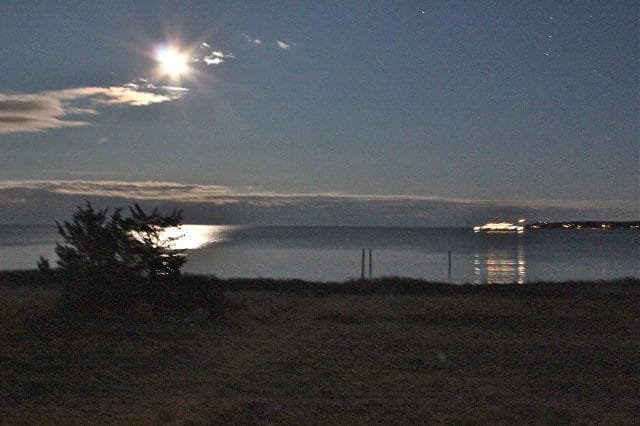 We needed to chase the moon, the ferry, the stars! We got the car and drove out West Chop to the Meadow for a clear view of the sound in time to see the ferry steaming toward Woods Hole. I think that’s one of the dippers up there in the sky on the right!
 A little further down, we came to the West Chop Lighthouse and there was the moon, giving us a beautiful shot. All of these photos were taken without flash — for some reason, there is a very strong light shining on the front of this house. This photo reminded us of an Edward Hopper painting. But we wouldn’t want to live here . . . who could sleep? See the stars?
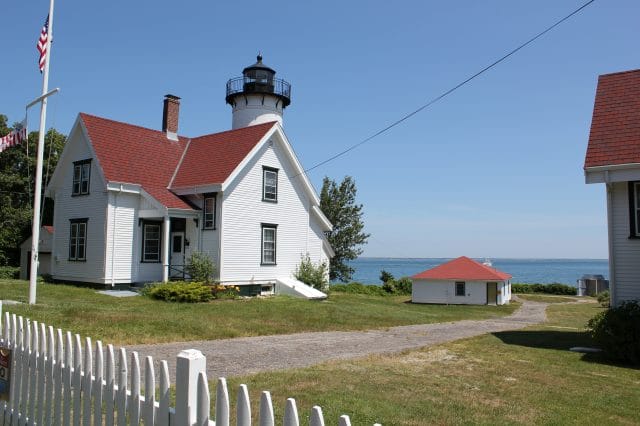 Thought you might like to see a daytime photo of the lighthouse (built in 1817) . . . just as wonderful!
 Finally back home, and there’s the moon, peeking through the linden trees over the roof of our house. And this wasn’t even the full moon! I think you can see why, first thing Monday morning, we Googled “time of moon rise on Martha’s Vineyard,” and planned our day around 5:10 pm last night. When the time finally came, we got our hats, gloves, scarves, big jackets and drove to East Chop. We got there early and waited, so excited, as it got darker and darker, scanning the water line, asking each other 10,000 times, “Where do you think it will come up?” And, “Do you see a little light over there?” Trying to pinpoint the spot it would rise. And then, finally, “There it is!!!”

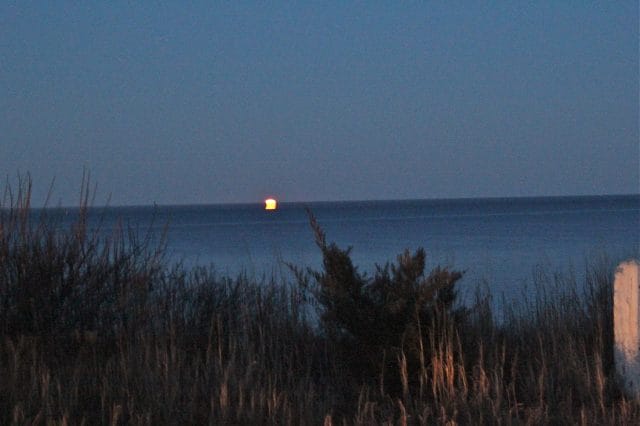 Why is this so exciting? I don’t know. But most of what you’re seeing is reflection on the water; it’s really just a little sliver of a moon, so far, skimming the water line.
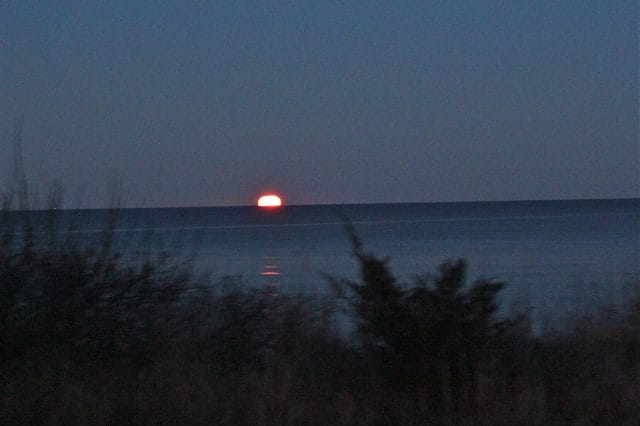 And then we were treated to a bit of a light show. . . sparking pink on the water . . .
 Then turning yellow. Hello.
 Lighting the ocean on fire for one perfect moment in time; how could it get any better than this?
 Here comes a fishing boat going home to Menemsha, about to cross the path of the moon; how must it feel to be on that boat?!!! The put-put sound of the engine, the clanging of the rigging, the smell of the sea in the cold wind, the water rushing past the bow, and then, the moon. Lucky!
 I hope they did! ♥

So, after taking about 200 photos of this view :-), we got back in the car and drove along the north shore taking more pictures as we went . . .
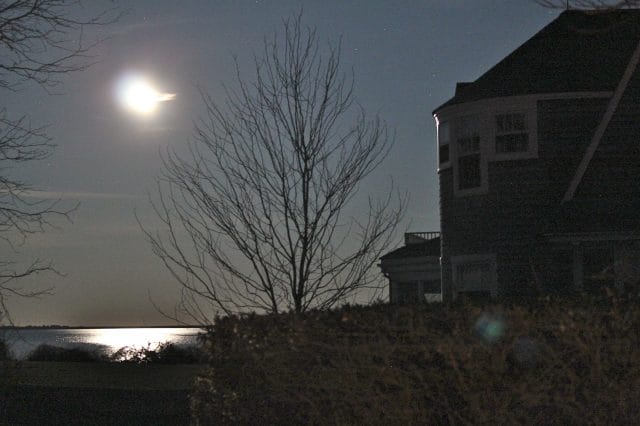 What a view — I wonder if the owners of this house are inside but turned off the lights to watch this??? I would. And I’d be playing this music too! ♥ Bella Luna!
 This is the Edgartown Lighthouse . . . see the red light? It blinks! I got it!! 🙂 So wonderful that we are digital now . . . otherwise I would have gone totally broke on the film for this little outing!
 And yet, I will publish an out of focus picture like this! But how could I not? We were “coming to” from being moon drunk, and began to notice how beautiful the Edgartown architecture looked in the moonlight, details gleaming white in the dark.
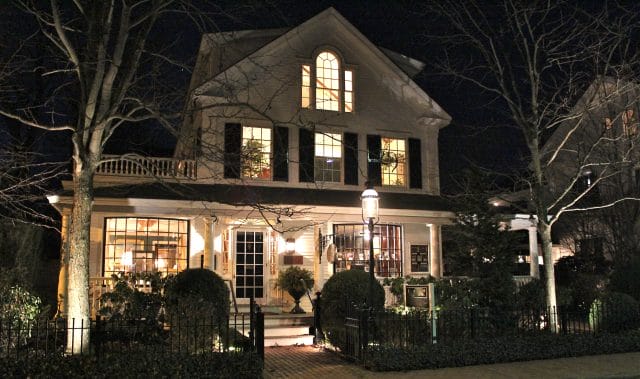 Edgartown is a very pretty little New England town. But it’s a summer town; almost all the businesses close down in the winter, and many of the homes are occupied only during the summer. If you are ever looking for peace and quiet, Edgartown in the winter is the place to go. This is part of the Charlotte Inn, one of the prettiest Inns on the island.
 The beautiful Federated Church . . . built in 1828; the congregation was established in 1642. But I digress. How can I help it. Sublime beauty calls.
 It was a wonderful drive back to our neighborhood . . . the moon shined its light on us the whole way. ♥
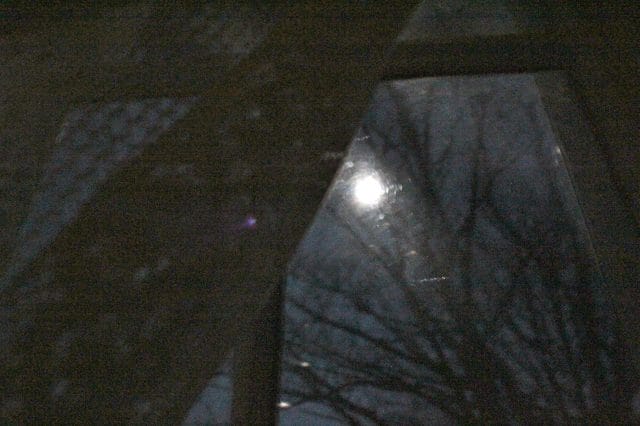 Full moons wake me up…. I think I have thin eyelids or something, because I’ve always been able to sense or “see” light even with my eyes closed! Here’s the moon around 2 am this morning.
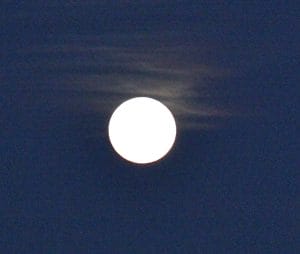 If you have my calendar, you already know that Native Americans called the first moon of the year the “Wolf” moon. They had nature-inspired names for all the moons; next month it will be the “Snow” moon. I recently gave away a Bookmark that includes the dates of the full moons for 2012 and all the Native American names for them . . . in case you just came here from Willard and missed it, here it is again. Click on “bookmark” and you can print it out and become a moon chaser yourself. It was really fun; next time I’m packing a picnic! I think a soft little roast beef and lettuce sandwich, heavy on the mayo, lots of salt and pepper, would be very nice in the warm car with the moon shine. (Notice moon shine is two words! :-))
 OK girls, you probably know by now, we have a special give-away today, Valentine’s Day is coming . . . I mentioned in the Willard that I was giving away a signed copy of one of my Love Books, but I’m really giving away two! To the same person! ♥ One for whoever wins the random drawing, and one for the winner to give away to someone they love! I hope one of those two books goes to YOU!!! All you have to do is leave a comment (just click on the little gray word “comment” at the bottom of this post), and that will enter you in the drawing. I’ll let you know who the winner is in a couple of days. Until then, have a wonderful day girlfriends, be good to yourself! ♥


 I can’t give you hyacinths today, but I can give you violets!
  A bright and pretty picture like this definitely feeds my soul!


 Tuesday morning and ending late Wednesday evening, the first
  And guess what, it’s virtual! Fat free; no calories at all! And it comes with all the love that’s baked into any birthday cake, and candles for you to make a wish on . . . Happy Birthday Grandma! And to anyone else who might be celebrating this lovely day!
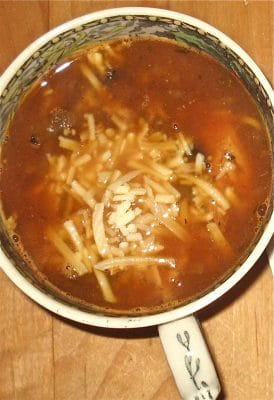
 And this is the last one for today . . . as promised, it’s my favorite recipe for low-fat, high-energy chicken soup that will warm you, heart and soul. Now that you have your rich chicken stock all ready (you do don’t you? 🙂 If you have no idea what I’m talking about, scroll down to the next post for that recipe), here’s how to make the soup.
 portobellos, shitake, and also regular white ones; dried ones too if you like; reconstitute them by soaking them in a little cool broth for a half hour before slicing and adding them to soup. They have a nice texture.
 onions; cook and stir until brown and caramelized. When they’re done, stir in the garlic, let everything cook about a minute more, then add it all to the stock. Also add the reserved mushrooms. Using a whisk (because it has a tendency to want to clump) stir in the tomato puree. Bring it all to a simmer. Add the bite-sized chicken and chopped parsley. Taste and then add salt and pepper — I usually start with a half teaspoonful of salt and move up from there — I like lots of pepper. The soup is delicious with just a bit of grated cheddar or Parmesan cheese
  over the top. It’s wonderful just like this, plain and simple, but I often throw in lots of